


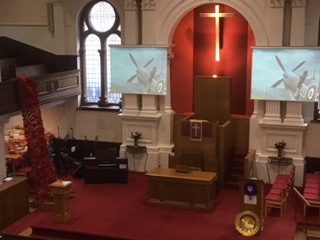
On Sunday 11th November 2018, St George’s marked Remembrance Day with a special service to pay tribute to members of St George’s Church who lost their lives at war. Thanks to Audrey Millar for conducting the research and delivering such a moving service and exhibition.

Find out more…
At the outbreak of WW1 in August 1914, the Reverend Duncan Ross, minister of St. George’s United Free Church, was out of the country, preaching in Interlaken, Switzerland. The UFC had 22 outposts abroad and Mr. Ross had accepted an invitation to preach to English speaking visitors throughout the summer. During these early days of uncertainty in 1914, visitors to the country were advised by the Consul to wait for special refugee trains and not to make their own way home. Mr. Ross was put in charge of a group of 25 people, who had their names written on the back of his passport. Fortunately, the journey through Europe went smoothly and our minister arrived safely back in Dumfries.
1917 saw Mr. Ross setting out to serve the soldiers at the Western Front for four months. The UFC had made an appeal for ministers to volunteer for work in their church huts and in Y.M.C.A. camps. He left for France on the 10th April 1917 to take charge of the Murray Memorial Hut behind the trenches, the huts acting as a place of sanctuary, rest and entertainment for the soldiers. At the outbreak of WWII in 1939, Mr. Ross was still our faithful minister but he retired from active ministry at the end of 1941 and the Reverend George Logan ably led the congregation through the remainder of the war years.
While the men and women were away on service during WW1, our congregation came together and did what we still do today…we worked as One Body, to get things done.
Determined that the soldiers would not be forgotten, the Woman’s Guild, the Mothers’ Meeting and the Girls’ Auxiliary formed a Work Party, meeting once a week to prepare comforts for the troops. Donations such as cigarettes and chocolate, cocoa, cakes of soap and boot laces were handed in to be distributed amongst the regiments. Christmas gifts were sent to everyone on our Roll of Honour, including our nursing sisters working in military hospitals. Each parcel contained a personal letter from the minister and a copy of the New Testament. Garments such as shirts, mufflers and mitts were sewn and knitted. In 1914, Lord Kitchener made a special appeal for socks to combat trench foot and within three months, our ladies had knitted 219 pairs to be sent off to the troops in France.
In 1915, Mrs. Agnes Kirk received a letter from her son John who was in the KOSB. Describing conditions in Gallipoli, he writes ‘It is an awful place. If you get a slight cut in your hands, the wound is poisoned in no time. The flies are in millions here. At nights, it is cold. It is a week now since I had my boots off.’ Here then is a soldier who would surely look forward to the simple pleasure of receiving a parcel containing hand knitted socks and mitts from home. Second Lieutenant Kirk was to die in Belgium in 1918 aged 24 years.
The church magazines were published quarterly, each issue containing a Roll of Honour which was kept up to date with personal details of each soldier’s welfare.
There are 179 soldiers on the Roll of Honour for WW1, serving in France, Belgium, Egypt, Palestine, Turkey and Russia. Thirty one of our men did not return home from the First World War. Six of our men did not come home from the Second World War. The soldiers who died in both wars were all aged between 21 and 41 years.
There are still family connections with two of our soldiers in St. George’s Church. Church member Miss Noreen Derby is the niece of Private Henry (Harry) Niven Shaw, who died in 1940 during the evacuation from Dunkirk.
And the late Mr. John Wallace, husband of Mrs. Margaret Wallace, was the nephew of Private George Wallace and his brother Sapper John Wallace, who both fell in WW1. This means that Margaret, the daughter of Mr. and Mrs. Wallace, is the great niece of our two soldiers.
Our church has two war plaques. Our WW1 memorial was unveiled on Sunday, January 29th 1921, but unfortunately it contains two mistakes. Private William MacDonald Grier of the Royal Scots, who fell in action in Russia in 1918, has been named in error as Ronald Grier. Secondly, Gunner Hamilton Cameron Gracie, of the Royal Field Artillery, has been missed from the memorial. Hamilton was one of the first men to enlist and was both wounded and gassed. He was demobilised in January 1919 but enlisted again and died in action in Russia five months later.
We commemorate servicemen and women killed in all conflicts.
Today marks one hundred years since the end of the First World War. Let us give thanks and remember with honour all the servicemen from St. George’s Church who laid down their lives for us in the two World Wars. Ordinary men who were baptised and brought up in our church, who came here to worship God with their families and friends, who shared in the life of our congregation, who sat in the very same pews we occupy today, shared in communion and were part of the Body of Christ.
‘Their names liveth for evermore’.
Contact: Audrey Millar